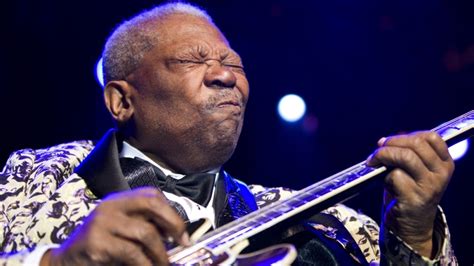
B.B. KING – 5MBS BLUES LEGEND
B.B. King was not born. He was a gift from the Rhythm Gods. Born Riley B. King onSeptember 16, 1925, near Berclair, Mississippi, he grew up in a poor farming community. Not too surprising, his early experiences with gospel music and the blues helped shape the sound that would later make him famous. Although his childhood was difficult, leaving school by the age of 14 to work picking cotton, music became an important part of his life and eventually gave him a path to success.
As a young guitarist, BB King was influenced by Blind Lemon Jefferson and Lonnie Johnson – with the former being rhythmically, intricate and lyrically dark blues, and the latter more cool, urbane and stylistic, and let’s not ignoring the jump blues of Louis Johnson. Combined with the hard life of the cotton fields and gospel from the Church of God, BB King found new turf where heart and soul could be delivered into music.
Riley B King was born of the delta, raised in the delta and delta scared. “Sing blues, singing about your sadness, unburdens your soul” BB once said. The Blues was about survival on the (white owned) plantations. On the plantations BB learnt about hard work and learnt about faith and music. The Reverend Fair was the first to encourage BB King to play the guitar and his Aunt Mima has a Victrola record player and a stack of records. Bringing in gospel and the then most mainstream music style was country, such as Jimmy Rogers, Riley King was a virtual musical cauldron. Not just sound, but style. Riley learnt about showmanship from Booker-T Washington White (or ‘Bukka’ White), his cousin, who as an
early flashy bluesman, and greatly influence Riley.
There have been many influential musicians that Riley King credits with evolving his music. There were broad jazz influences from Benny Goodman’s band; the guitar work of Charlie Christian; and even US soldiers returning from Europe with Django Reinhardt LPs. However, BB King sights T-Bone Walker as his most important influence. “When I Heard Aaron T-Bone Walker, I flat-out lost my mind” King wrote in his autobiography, “Thought Jesus himself had returned to earth playing electric guitar”.
There is much more to the story of Riley King, however, as a young man, King moved to Memphis, Tennessee, where he began working as a radio performer and musician. He became known as the “Beale Street Blues Boy,” a nickname that was later shortened to B.B. King. His initial gig and performing break came in the form of good fortune to fill in for Sonny Boy Williamson, at the 16 th Street Grill in West Memphis. He was offered a steady job at the Grill, of six nights a week at $12 a night, on the understanding that he would get a radio gig and mention the 16th Street Grill on air.
BB King’s career began to grow during the 1950s, when he recorded songs and performed across the United States. Unlike some blues musicians who played several instruments, King became especially famous for his electric guitar playing -on and with Lucille. And his guitar, named Lucille, became an important part of his identity. Named after the woman who caused a fight in a juke joint, resulting in a fire, where BB King and, so the story goes, ran back into this fire to rescue his guitar… and his livelihood.
King developed a distinctive style that focused on emotional, expressive notes rather than playing many notes quickly. His guitar solos often sounded like a human voice, full of sadness, joy, and feeling. This unique style influenced generations of musicians, including rock and blues guitarists. However King said that he continued to learn for all musos throughout his career, always looking to improve. King used to say that his father said “You don’t have to be the best, just be the best until the best comes along”. A musical philosophy that King practised until the day he died, on May 14, 2015, at the age of 89.
One of B.B. King’s best-known songs is “The Thrill Is Gone,” released in 1969. The song became a major hit and introduced his blues music to an even larger audience. Throughout his long career, King released numerous albums and performed thousands of concerts around the world. He also collaborated with many famous musicians, helping bring blues music to listeners who might not otherwise have discovered it.
B.B. King received many awards and honours for his contribution to music, winning numerous Grammy Awards and was inducted into the Rock and Roll Hall of Fame in 1987. He was also recognised as an important cultural figure who helped popularise the blues internationally.
Beyond his musical achievements, King was admired for his personality and his dedication to performing. He continued touring well into his later years, often performing hundreds of shows in a single year. He believed strongly in connecting with audiences and sharing the emotions behind his music. His passionate guitar playing, powerful voice, and unforgettable songs established him as a true legend of the blues. B.B. King did more than play the blues: he helped introduce the genre to millions of people and ensured that its emotional power would continue to be heard for generations. And grew to be one of the most influential blues musicians of all time.