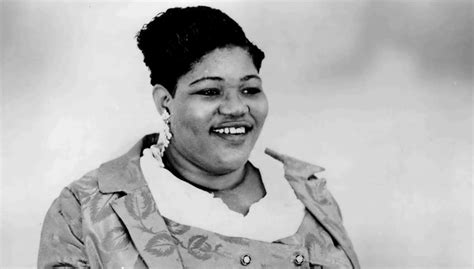
Big Mama Thornton: A Legendary Voice in Blues History
Mike Stoller (who with Jerry Leiber wrote ‘Hound Dog’) described Big Mana Thornton as “The biggest, baddest, saltiest chick you would ever see.” She was gay, fearless and utterly unique, Thornton had a hit with Hound Dog before Elvis – but was then fleeced and forgotten. And now one hundred years after her birth, 5MBS proudly presents Big Mama as our Blues Legend for December.
Born Willie Mae Thornton on December 11, 1926, Alabama, she is one of the most influential figures in the history of blues music. Her commanding voice, raw emotion, and vibrant stage presence made her a standout artist during a time when blues was deeply intertwined with the social and cultural fabric of American life.
Willie Mae “Big Mama” Thornton exuded uncompromising intensity. Her voice conveyed struggle and defiance, fury and hurt, like few others. Standing at 6ft 2in, and at times weighing 150 to 200 kg, with an imposing physique, she was a multi-instrumentalist who refused to let a racist society or a rapacious industry confine her.
She was introduced to music in a Baptist church, where her father was a minister and her mother a singer. She was later introduced to gospel music by the church, which heavily influenced her artistic side. Thornton’s mother fell gravely ill from tuberculosis, and at 13 years of age, Thornton cared for her mother until her death in 1939. At the time Thornton was in third grade, however after losing her mother she was unable to continue to attend school, and leaving school got a job washing and cleaning in a local tavern. Yet Thornton’s talent was self-taught. She was discovered in 1940 when she was 14 years old. Diamond Teeth Mary, the half-sister of Bessie Smith, encouraged her to enter a talent contest after having heard Thornton singing while working a side-job on a garbage truck. She won!
Big Mama began performing alongside comedians, dancers and musicians in the touring Hot Harlem Revue, which featured predominantly gay and lesbian performers (including a young Little Richard), which suited Thornton, who preferred menswear and never hid her sexuality, yet the revue paid so poorly she had to shine shoes prior to performances.
Settling in Houston, Texas, in 1948, she signed with Duke and Peacock Records, and when the Johnny Otis Orchestra came to town, he recruited Thornton, giving her the “Big Mama” stage name. And it was Otis who asked songwriters Mike Stoller and Jerry Leiber to write a song for her, resulting in the legendary “Hound Dog.”
Thornton’s breakthrough in 1952 was recording “Hound Dog”. Her version was gritty, bold, and deeply soulful, delivered with a commanding growl and a rawness that captured the frustrations and spirit of the era. This recording became a number one hit, staying at #1 in the R&B charts for 7 weeks, sold over 500,00 copies, and showcased her as a force to be reckoned with in music. However, she was paid minimal royalties, around $500. Today, Thornton’s song is credited as helping to usher in the dawn of rock and roll.
Beyond “Hound Dog,” Big Mama Thornton contributed significantly to blues and R&B with other songs such as “Ball and Chain” and “They Call Me Big Mama.” She was known for her commanding stage persona—often playing the harmonica and guitar—bringing a powerful physicality to her performances. She taught herself to play the drums, since she was ‘sick of drunk drummers.’ Her music carried themes of empowerment, hardship, and resilience, which resonated with African Americans facing systemic inequalities.
In the 1960s, Thornton experienced a resurgence during the blues revival movement performing with members of the Grateful Dead, and she continued to perform and record well into the 1970s. Legendary musicians like Janis Joplin cited Big Mama Thornton as a significant inspiration with Joplin recording ‘Ball and Chain’; — Joplin’s raw, emotive style owes much to Thornton’s groundbreaking expressiveness.
In 1965, Thornton toured Europe with the American Folk Blues Festival, touring with Willie Dixon, John Lee Hooker, Buddy Guy plus others, and she was celebrated by adoring fans. While in London on October 20, she recorded her first album for Arhoolie, Big Mama Thornton – In Europe, with backing by blues veterans including Buddy Guy (guitar) and Walter “Shakey” Horton (harmonica).
By 1969, Thornton had signed with Mercury Records, which released her most successful album, Stronger Than Dirt, which featured on the Billboard Top 200 record chart, and later an album of gospel music called Saved.
Thornton’s legacy is not just about her powerful voice or pioneering hits; it’s also about breaking barriers. As a large African American woman in a both male-dominated and racially biased industry, she pushed against stereotypes and expectations. Her music embodied strength and authenticity, reminding audiences of the blues’ roots in real-life struggle and emotional depth.
Despite her influence, Big Mama Thornton received little commercial success or recognition as did her male counterparts during her lifetime. Thornton’s death at 57 was barely noted, perhaps because, in the eyes of the music industry, she was a one-hit wonder. ‘Hound Dog’ was re-defined by Elvis!
Thornton was found dead in a Los Angeles boarding house on July 25, 1984, having died of heart and liver disorders caused by her longstanding alcohol abuse. She had lost 160kg because of illness, weighing only 43 kg when she died. Thornton was buried in Inglewood Park Cemetery in Los Angeles in a pauper’s grave featuring a small granite marker with two additional names, indicating her body was buried along with two strangers.
Big Mama Thornton’s story is a testament to the resilience of artists who navigate social and industry challenges to leave an indelible mark on culture. Her powerful voice and indomitable spirit remain an essential chapter in the story of American music history. And Big Mama Thornton is the 5MBS Blues Legend for December.